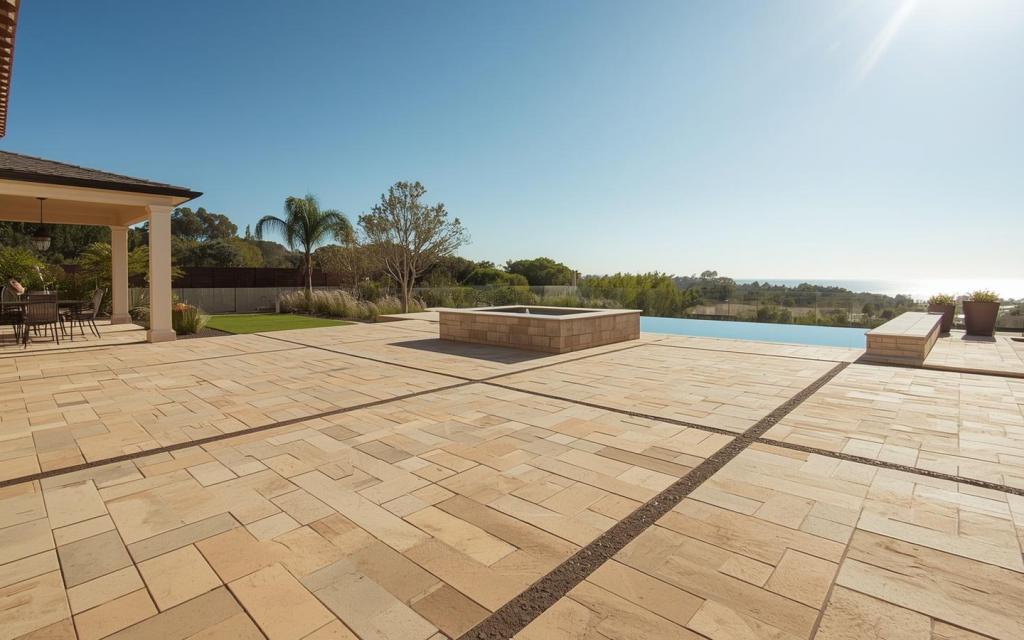
A paver driveway is the hardest-working surface on your property and the first thing anyone sees. It also carries loads nothing else in your yard has to handle — and that is why it is built to a different specification than a patio, not simply a patio that cars park on.
Get the base and the drainage right and a paver driveway will outlive a poured slab, because it flexes with our expansive soils instead of cracking, and because any section of it can be lifted and re-laid. Get them wrong and the failures show up exactly where the tyres turn.
Why vehicle loads change the build
Foot traffic pushes straight down. A car does something more destructive: it concentrates weight onto four small contact patches, and when it turns, it applies sideways shear at the same time. That combination is what finds a weak base.
- Thicker units. Driveway pavers are typically 80mm rather than the 60mm common on patios. The extra thickness is what resists point loading and edge chipping under tyres.
- A deeper compacted base. Where a patio is fine on roughly 4–6 inches of compacted class II, a driveway generally wants 8–12 inches depending on the soil beneath it. On poor or clay-heavy subgrade it can be more.
- Compaction in lifts, not one pass. Base material goes down in layers, each compacted in turn. A deep layer dumped and rolled once is compacted at the top and loose underneath.
- Geotextile separation between subgrade and base on soft or clay soils, so the two don’t migrate into each other and the base doesn’t slowly sink into the ground.
- Heavier edge restraint. The perimeter of a driveway takes far more outward force than a patio’s. Without a properly spiked restraint the edges creep and the whole field loosens from the outside in.
The general principles of a correct paver build are on our main paver installation page. Everything below is the part that applies only to driveways.
Herringbone isn’t a style choice here
On a patio, laying pattern is aesthetic. On a driveway it is structural. Herringbone — at either 45 or 90 degrees — interlocks each unit against its neighbours in two directions, so a tyre load is distributed across many pavers instead of pressing one downward on its own. Running bond and stack bond have continuous straight joints, and those joints let units walk under repeated shear.
Between the two angles: 45-degree herringbone is the stronger choice against traffic running straight up the drive, and it looks less rigid. 90-degree reads more formal and produces fewer cut pieces along straight edges. Either is correct; a stretcher-bond field in a driveway is not.
A soldier-course border around the perimeter does real work on a driveway as well as looking finished — it gives the edge restraint a clean line to hold and absorbs dimensional variation at the edges rather than in the middle of the field.
The two transitions that matter most
Almost every driveway complaint traces back to one of its two ends.
The street apron. The section where your driveway meets the public street usually sits in the public right of way, which means the city — not just your property — has a say in it. That commonly requires a separate encroachment or right-of-way permit, and the apron itself often has to be concrete to a specified detail rather than pavers. It also has to match the existing gutter and sidewalk grade so water keeps running down the gutter instead of pooling at your entrance. This is a detail to establish before design, not during construction.
The garage threshold. The driveway has to meet the garage slab flush, and it has to slope away from the opening. If new pavers finish even slightly high at the door, or the fall runs the wrong way, you have built a channel that delivers rainwater into your garage. Where the existing grade makes that unavoidable, the answer is a channel drain across the opening tied into a real outlet — not a hopeful bead of sealant. Getting this wrong is expensive to fix afterwards because it means lifting and re-basing the top of the drive.
Drainage, slope and where the water actually goes
A driveway is a large impermeable surface aimed at your house, so its slope is not a detail. It needs consistent fall away from the garage and the foundation — typically around a quarter inch per foot — and that water needs a destination: the street, a swale, an area drain, or a dry well.
On a wide driveway a crown down the centre or a deliberate cross-slope to one side moves water off faster than a single flat plane. Where the drive runs downhill toward the house — common on hillside lots — a channel drain across the low point is the standard solution, and it has to be sized and outletted properly rather than dropped in as an afterthought. Driveways that sheet water onto a neighbour’s property are also a problem worth designing out early.
Permeable pavers are genuinely worth considering for a driveway. Wider joints filled with open-graded aggregate let water pass through into a stone reservoir instead of running off, which can solve a drainage problem rather than relocating it, and may help with stormwater requirements on some projects. The base build is different — an open-graded reservoir rather than conventional class II — so it’s a decision made during design.
Size, shape and turning
Width is worth thinking about properly, because widening a driveway later means re-basing the new strip and it rarely matches perfectly. A single-car drive is workable but tight once anyone needs to open a door beside a wall or a planter. A double-width drive is what most households actually want, and a little extra beyond the minimum buys the difference between parking comfortably and shuffling cars.
The other dimension people forget is the turning and backing area. If you have to reverse out onto a busy street, a wider apron or a turnaround bay changes daily life more than any material upgrade. And if the drive has a bend, the inside radius has to accommodate the car that actually uses it — a tight radius means tyres repeatedly track over the same inside edge, which is precisely where an under-built base shows up first.
Steep driveways deserve a specific look. Beyond a certain grade the concern stops being traction and becomes the transitions: a sharp break at the top or bottom will scrape a low front bumper. Those breaks want to be eased with a vertical curve rather than a hard angle, and that’s a grading decision made before any base goes in.
Replacing an existing concrete driveway
Most of our driveway work replaces cracked concrete, and the first question is always whether to remove it or lay over it.
Removal is usually the right answer. It lets us build a proper base, control the finished height at the garage and the apron, and it means a slab that is already failing isn’t left under your new surface to keep moving. The cost is demolition and disposal, and concrete is heavy — this is a real line item, not a footnote.
Overlaying can work when the slab is genuinely sound, drains correctly, and the added height doesn’t create a problem at the garage threshold or the street. Those conditions are less common than homeowners hope. Overlaying a slab that already has significant cracks or holds water just conceals a problem that will telegraph through the new surface. We’ll tell you honestly which situation yours is after looking at it.
Living with it: maintenance that’s specific to driveways
Driveways get treatment no patio does, so their maintenance list is different:
- Joint sand in the wheel paths depletes faster than anywhere else and eventually wants topping up. That’s normal wear, not a defect.
- Oil and transmission drips are the most common staining problem. Fresh spots lift far more easily than old ones, and a sealed surface buys you time to get to them.
- Sealing is optional but more worthwhile on a driveway than elsewhere — it makes automotive stains recoverable and deepens colour. It needs redoing periodically.
- Efflorescence — the temporary white haze on new concrete pavers — is a curing phenomenon, weathers off on its own, and is not a defect.
- Individual damaged units lift and get replaced. Keeping a few spare pavers from the original batch is genuinely useful, because colour runs change over the years.
- Heavy delivery or RV loads are worth mentioning at design time. If a motorhome or a regular heavy truck will use the drive, the base should be specified for it from the start.
What drives the cost
- Square footage, and whether the shape is a simple rectangle or involves curves and a turnaround.
- Demolition and disposal of an existing slab.
- Excavation depth and spoil export — a driveway’s deeper cut generates real volume to haul away.
- Subgrade condition — soft or clay-heavy ground means more base and geotextile.
- The apron, plus any right-of-way permit and the concrete detail the city requires.
- Drainage work — channel drains, area drains, or a dry well.
- Paver choice — standard concrete units versus large-format or premium finishes.
- Grade changes — a steep drive needs its transitions built, and sometimes a retaining wall alongside. See retaining walls.
- Permeable construction, which uses a different and generally deeper base.
Common questions
Will a paver driveway hold up to cars as well as concrete?
Built to driveway specification, better in our soils. Concrete is a single rigid slab, so ground movement cracks it and the crack is permanent. A paver field flexes, and any damaged area can be lifted and re-laid invisibly.
Do I need a permit for a driveway?
Replacing a driveway within your property line often doesn’t require a building permit, but work in the public right of way at the apron generally does, and anything that changes site drainage can trigger review. Many HOAs also review driveway material and colour. We establish all of that at the start.
How long will my driveway be out of use?
Longer than a patio, because of the demolition and the deeper base work. Plan on parking elsewhere for the duration — we’ll give you the sequence up front, including when the apron is affected, since that’s the part that blocks access entirely.
Can you match my existing walkway or patio?
Usually, and it’s worth doing — a driveway, entry walk and front patio reading as one material makes the whole frontage look intentional. Bear in mind the driveway needs the thicker unit, so we may match colour and family rather than the identical paver.
Do weeds grow between driveway pavers?
Not up through a correctly built base. Weeds in joints are windblown seed germinating in degraded joint sand or accumulated debris on the surface — which is why topping up polymeric sand and keeping the surface clear handles it.
What about the strip between the sidewalk and the street?
That parkway strip is typically city-controlled, and what you’re allowed to do with it varies by jurisdiction — including whether it can be paved at all. We check it rather than assume, because it’s a common source of after-the-fact problems.
What base depth does a paver driveway need?
Driveways carry vehicles, so they get a much deeper section than a patio: typically eight to twelve inches of compacted Class II road base on clay soils and never less than six on well-drained ground, plus geotextile fabric between the soil and the base. The base is compacted in thin lifts with a plate compactor or roller. This unseen work is what keeps wheel paths from rutting years later.
Can a paver driveway handle an RV or a heavy truck?
Yes, when it is designed for it. Heavier vehicles mean thicker pavers, a deeper base, and sometimes a pattern such as herringbone that resists the twisting force of tires. Tell us the heaviest vehicle that will park there, including a trailer, boat or motorhome, and we size the section accordingly. A driveway built only for cars will eventually show tire tracks under an RV.
Will a paver driveway settle where cars park?
Not when the base is built correctly. Settling under parked cars is almost always a sign of a shallow or poorly compacted base, or of water getting under the pavers. A driveway with proper base depth, compaction and drainage holds its grade. And if a spot ever does dip, individual pavers can be lifted, the base corrected and the pavers reset with no visible patch.
How does drainage work on a sloped driveway?
The driveway is graded so water runs to the street or to a drain rather than toward the garage. On steeper drives a trench drain across the garage apron catches runoff before it enters. Pavers help because their joints let some water through, and permeable pavers can take all of it. We also make sure the base does not become a channel that carries water toward the house.
How do you deal with oil stains on driveway pavers?
Concrete pavers are porous, so a fresh oil spot should be absorbed with cat litter or a degreaser as soon as possible. Set-in stains usually lift with a paver-specific cleaner. If a stain will not come out, that individual paver can simply be replaced, which is one of the practical advantages over a concrete slab. A penetrating sealer makes cleanup easier and is worth considering on a driveway.
Can you add a border, band or pattern to a driveway?
Yes. A contrasting border along the edges, a band across the apron or a change in pattern at the garage door gives a driveway a finished, designed look. Herringbone is the strongest pattern under traffic and works well as the main field with a soldier-course border. We draw the layout so cuts fall in the right places and the pattern lines up with the garage and the walkway.
How long does a new paver driveway need before I can park on it?
You can typically drive on a paver driveway within a day or two of completion, once the joint sand has set and the edges are secured. There is no multi-day cure like poured concrete. We will tell you the exact timing based on the joint material used.
Get a driveway quote
We’re a licensed San Diego general contractor, CSLB #1159596. Call (858) 392-6767 and we’ll look at the existing surface, the apron, the garage threshold and where water currently goes — those four things determine the build before anyone picks a paver. See also paver patios and driveways for the general build standard, or the full outdoor living scope.
Where we build this
Searching for paver driveway installation near you? IO Builders Group handles paver driveway installation across San Diego County from our Scripps Ranch office, including:
Also serving Rancho Bernardo, Encinitas and Solana Beach. Licensed design-build general contractor, CSLB #1159596.