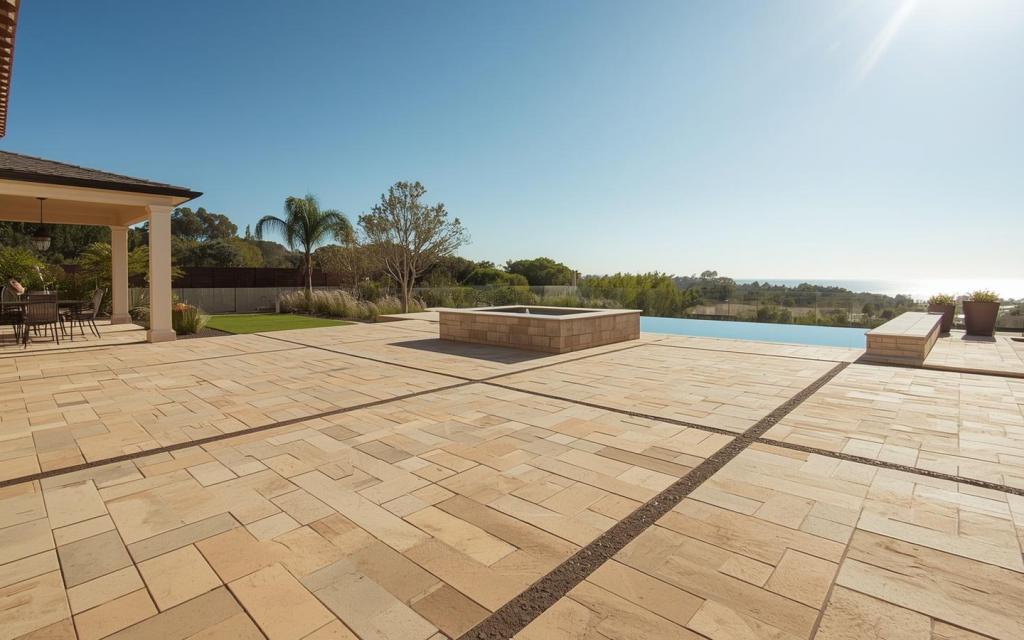
New flooring transforms a home faster than any other single project — and flooring is 80% preparation. Floors fail at the subfloor: unlevelled slabs telegraph through vinyl, moisture wicks into laminate, and hollow tile announces every shortcut underneath. We flatten, patch, and moisture-test before the first plank or tile goes down.
What we install
- Luxury vinyl plank (LVP) — today’s most popular floor for good reason: waterproof, durable, and convincing wood looks
- Tile and large-format porcelain
- Laminate
- Engineered hardwood
- Baseboards and transitions, finished clean
Most San Diego homes sit on a slab — and that changes everything
Slab-on-grade construction dominates here, and a concrete slab behaves nothing like a wood subfloor. Two properties of it decide which floors will work in your house and which will fail:
Flatness. Slabs are poured to a tolerance that was fine for carpet and is not fine for a rigid plank or a large tile. High spots have to be ground down and low spots filled with self-levelling compound. Skip it and you get flex and hollow spots under LVP, and lippage under tile — one tile edge standing proud of its neighbour, which you feel with a bare foot and see in raking light. Lippage is a substrate failure, not a tiling failure, and there’s no fixing it after the fact.
Moisture. Concrete passes water vapour up from the ground continuously, and an older slab often has no vapour retarder beneath it at all. That’s why a floor can be installed perfectly and still cup, buckle or delaminate a year later. The answer is to test rather than guess — a relative-humidity probe reading in the slab, or a calcium chloride test — and then, if the reading warrants it, install a moisture-mitigation membrane or choose a floor that doesn’t care. This single step is the difference between a floor that lasts and a warranty claim, and it’s the one most commonly skipped on a low bid.
Choosing the material
Luxury vinyl plank. Fully waterproof, forgiving, and the default recommendation for most of a house. The spec that matters is the wear layer thickness — measured in mils, and the single best predictor of how the floor survives dogs, chairs and grit. A thin wear layer is where budget LVP gives itself away. Rigid-core (SPC) planks are denser and hide minor substrate variation better than the older foam-core products; click-lock floats over the slab, glue-down is more stable underfoot in very large runs and in rooms with big temperature swings.
Tile and porcelain. The most durable and the most permanent. Over a slab, an uncoupling membrane between slab and tile is worth every cent — it isolates the tile from small movements and shrinkage cracks in the concrete so a crack in the slab doesn’t become a crack through your floor. Large-format tile looks superb and demands the flattest substrate; that’s the trade.
Laminate. Cost-effective with excellent photographic realism and a hard wear surface. Its weakness is water at the edges — a standing spill that sits will swell the core. Water-resistant products have improved a great deal, but in a genuinely wet room LVP or tile is the sounder choice.
Engineered hardwood. Real wood, and the only wood floor we’d put over a slab — it’s dimensionally stable in a way solid hardwood isn’t, and it’s typically glued down. The number to ask about is the wear-layer veneer thickness, because that determines whether the floor can ever be refinished or only ever replaced. Solid hardwood over a slab is a fight with physics and we’ll generally steer you away from it.
Which floor for which room
- Whole-house continuity — one floor running through the main living areas makes a house feel considerably larger than changing material at every doorway.
- Kitchens — LVP or tile. See kitchen remodeling if cabinets are also changing, because the order matters.
- Bathrooms — tile, or LVP in a secondary bath. See bathroom remodeling.
- Bedrooms — anything, including carpet if you want quiet and warmth.
- Entries and hallways — the highest-wear areas in the house; spend the wear layer here.
- Garages and laundry — tile or sealed concrete.
- Patios and outdoor rooms — a different problem entirely; see our guide to outdoor flooring and pavers.
The details that make a floor look installed rather than laid
- Acclimation. Material sits in the house before installation so it’s at the temperature and humidity it will live at.
- Expansion gaps. A floating floor has to be able to move at the perimeter. Pinch it against the walls and it buckles — one of the most common failures in a DIY installation, and it’s not repairable without lifting the floor.
- Plank direction and layout. Running the long dimension of the plank along the long axis of the room, and setting the starting line so you don’t finish with a sliver at the far wall.
- Door undercuts rather than quarter-round bumped up against casings.
- Threshold heights. A new floor changes finished height; doors may need trimming and transitions to adjacent rooms need to be level and not a trip edge.
- Baseboards. Removing and reinstalling baseboard gives a far cleaner result than shoe moulding hiding a rough edge.
- Appliance and toilet handling — pulled and reset properly, with new supply connections and a fresh wax ring rather than reused ones.
What drives the cost
- Square footage, and how cut-up the floor plan is — many small rooms cost more per foot than open space.
- Material tier — wear layer on LVP, veneer thickness on engineered wood, tile format and finish.
- Slab preparation — grinding and self-levelling is the most common surprise line item, and it’s usually only fully known once the old floor is up.
- Moisture mitigation, if testing calls for it.
- Tear-out and disposal — removing old tile and thinset is heavy, dusty work and considerably more than pulling carpet.
- Uncoupling membrane under tile.
- Pattern complexity — herringbone, diagonal layouts and borders add cutting and waste.
- Stairs, which are priced per tread and are labour-dense.
- Baseboard replacement versus reinstalling the existing.
Common questions
What’s the best floor for homes with dogs and kids?
LVP, almost every time: fully waterproof, scratch-resistant, softer underfoot than tile, and a single damaged plank can be replaced. Ask about the wear layer — that’s the number that decides how it holds up.
Can you install over existing floors?
Sometimes — it depends on the existing material, height transitions, and condition. We’ll tell you honestly at the estimate; tear-out is often the better long-term call.
Why did my last floor cup or buckle?
Almost always one of two things: slab moisture that was never tested, or no expansion gap left at the perimeter. Both are preventable and neither is the fault of the product.
How long does it take?
A few days for a typical whole-floor LVP installation once prep is done. Tile takes longer because of setting and grouting stages. Slab grinding, levelling or moisture mitigation adds time up front, and self-levelling compound needs cure time before anything goes on it.
Do we need to move out?
Usually not. We work room by room or zone by zone where the layout allows. A whole-house floor replacement is smoother in an empty house, but plenty of clients stay and we sequence around them.
Is waterproof flooring really waterproof?
The plank is. The installation is water-resistant — a floating floor has seams, and a large volume of standing water will eventually find its way beneath and sit on the slab. It’s excellent against spills and pets; it isn’t a substitute for a shower pan.
Get an estimate
We’re a licensed San Diego general contractor, CSLB #1159596. Call (858) 392-6767 and we’ll look at the existing floor, check what’s under it, and tell you what prep the slab actually needs before quoting material. See interior remodeling for the full range, or whole house remodeling if flooring is part of a bigger project.
Where we build this
Searching for flooring installation near you? IO Builders Group handles flooring installation across San Diego County from our Scripps Ranch office, including:
Also serving Rancho Bernardo, Encinitas and Solana Beach. Licensed design-build general contractor, CSLB #1159596.