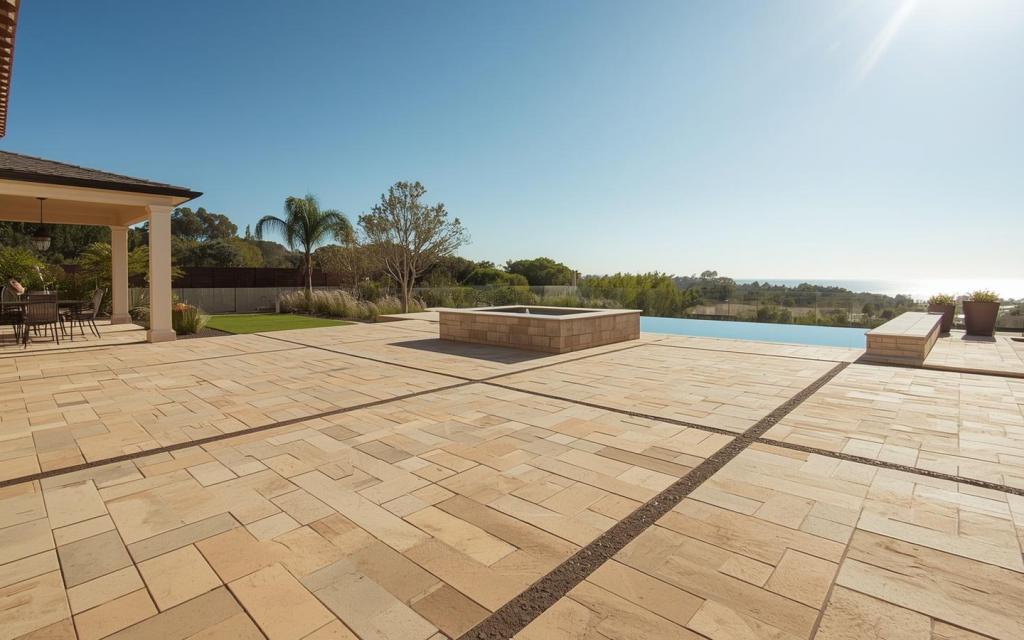
Escondido homes were made for indoor-outdoor living — bigger lots than the coast, real backyards, and hillside properties with views worth building for. They also come with Escondido realities: sloped lots that need engineered retaining walls, inland summer heat that makes patio covers essential rather than optional, and established homes from the ’70s–’90s whose kitchens and baths are ready for their second act. That’s our exact specialty, inside and out.
Inland heat changes what you should build
Escondido sits inland in a valley, and it runs meaningfully hotter in summer than anywhere on the coast — with a much bigger swing between afternoon and night. That single fact should reorder an outdoor living budget compared with a Del Mar or Carlsbad project.
- Shade is the highest-value item in the budget, not a finishing touch. A gorgeous paver patio with no cover is unusable from roughly midday through late afternoon for a third of the year. Get the patio cover into phase one.
- Surface temperature matters here. Dark pavers and dark turf infill in full inland sun get genuinely hot underfoot. Lighter-toned materials and mineral rather than rubber infill are worth choosing deliberately.
- Turf pays back faster inland. Keeping a natural lawn green through an Escondido August takes considerably more water than it does near the coast, which is exactly why artificial turf tends to pencil out sooner on these lots.
- The evening is the best part of the day. Lighting and a fire feature extend usable hours more than any additional square footage of paving, because that’s when an inland backyard becomes pleasant.
- Inside, cooling load matters. Shade over west-facing glass does more for indoor comfort than most people expect.
Sloped lots, and the walls that make them usable
A lot of Escondido’s most desirable property sits on the slopes around the valley, which is where the views are and also where the buildable flat space isn’t. Turning a hillside into usable yard is a retaining and terracing problem before it’s a patio problem.
On these lots the sequence is not negotiable: grade and drainage, then walls, then anything that sits on top. A terraced yard usually beats one tall wall — you get planting shelves instead of a single face, and each wall is a simpler structure — but terraces only behave as independent walls if they’re spaced far enough apart, which is an engineering question rather than a taste one. Walls over 4 feet measured from the footing bottom, or any wall carrying a slope, driveway or structure above it, need engineering and a permit. Full detail on retaining walls.
Drainage deserves extra attention on a hillside. Water arriving from uphill has to be intercepted and routed somewhere deliberate, and our expansive clay soils apply real force to anything holding wet ground. A wall that fails in Escondido almost always failed at its drainage, not its block.
What we find inside ’70s–’90s Escondido homes
Much of Escondido’s housing stock is now at the age where the original kitchen and bathrooms are on their second remodel rather than their first. Homes of this era share a fairly predictable set of conditions, and knowing them in advance is the difference between a firm scope and a series of change orders:
- Closed-off kitchens. The single highest-impact change available in a house of this period is usually removing the wall between kitchen and living area — which means a beam sized by an engineer, posts carrying to adequate support, and a permit. See kitchen remodeling.
- Electrical panels at capacity. Adding a kitchen’s worth of circuits, an induction range, EV charging or a spa often runs into a panel with nothing left. Worth checking before the design assumes it.
- Original drain and supply lines that reveal their condition the moment a wall opens.
- Bathrooms with no real waterproofing behind the tile, because the assemblies we consider standard now weren’t then. This is why we flood-test every shower pan — see bathroom remodeling.
- Slab-on-grade floors that need grinding, levelling and moisture testing before new flooring goes down. See flooring installation.
- Single-pane windows and thin insulation, which matter more inland than on the coast.
Escondido also has genuinely older homes, particularly closer to the historic core. Those bring a different list — plaster rather than drywall, raised foundations rather than slab, and occasionally wiring old enough that replacing it is the honest recommendation. We’d rather tell you that at the walkthrough than discover it at demolition.
Bigger lots are an opportunity — and a reason to plan the whole thing
Escondido parcels are frequently larger than their coastal equivalents, and that opens doors the coast doesn’t: a detached structure, a workshop, a pool, a genuine planting programme, or an ADU for family or rental income. It also means most owners build out over years rather than all at once.
Phasing works well if — and only if — the whole thing is designed first. Do the grading and drainage for the final layout in phase one, stub gas, water, electrical and irrigation for everything you eventually want, run conduit beneath any paving you install now, and build walls to the height the final plan needs. Then the kitchen, the cover, the turf and the spa can arrive in whatever order the budget allows, and nobody has to demolish finished work to reach a utility. On a large lot, that discipline is worth real money.
Permits in Escondido
Escondido is an incorporated city with its own building division, so permits and inspections for most addresses inside city limits go through the City rather than the County — and the process, the plan-check expectations and the timelines are its own. Addresses in the unincorporated pockets nearby go through the County instead, which is worth establishing early because it changes who reviews the drawings. Either way we handle permit applications, engineering when required, and inspections as part of our scope.
What typically needs a permit on these projects: retaining walls past the height threshold or carrying a surcharge, attached patio covers, gas and electrical runs for an outdoor kitchen, structural changes like removing a bearing wall, and anything that alters site drainage. Plan the calendar around review time rather than treating it as background paperwork.
What we build in Escondido
We build paver patios and driveways, retaining walls and terraced slopes, artificial turf that shrugs off inland summers, patio covers and outdoor kitchens — and inside, complete kitchen and bathroom remodels, flooring, and paint. One licensed team, one contract, familiar with City of Escondido permitting.
- Outdoor living — the whole backyard, designed as one project
- Paver patios and driveways
- Retaining walls and terracing
- Artificial turf
- Patio covers and pergolas
- Outdoor kitchens
- Whole house remodeling, plus kitchens, bathrooms, flooring and painting
- Room additions and garage conversions
Common questions
Do you handle Escondido permits?
Yes — permit applications, engineering when required, and inspections are part of our scope. We’ll also confirm at the outset whether your address is reviewed by the City of Escondido or by the County, because that determines the process.
My backyard is a slope. Is it even worth building on?
Usually yes, and often it produces a better result than a flat lot — terraces create distinct outdoor rooms that a flat rectangle doesn’t. The honest caveat is that the retaining and drainage work comes first and is a real share of the budget, so a hillside backyard costs more to make usable than a flat one costs to decorate.
What should I do first on a blank or tired backyard?
Drainage and grade, then any retaining, then utility stubs and conduit. Those are the things that are painful and expensive to add later. Shade comes next here because of the heat. Paving, turf and the kitchen can follow the budget.
Do you work on older homes near downtown?
Yes. Older stock needs a more careful look before anyone quotes it — foundation type, wiring, plumbing and plaster all behave differently from a 1980s tract home — and we’d rather scope that properly up front than write a number we have to revise.
Can you do interior and exterior in one project?
That’s what we prefer. One contract, one schedule, and a single mobilisation instead of two. It also means the inside and the outside get designed to relate to each other rather than being decided a year apart.
Talk to us about your Escondido project
We’re a licensed San Diego County general contractor, CSLB #1159596, working throughout Escondido and inland North County. Call (858) 392-6767 for a walkthrough — on a sloped or hillside lot the site visit tells us more in twenty minutes than any amount of description. Also serving San Marcos, and see all service areas.
What we build in Escondido
One licensed team for outdoor living and interior remodeling in Escondido: