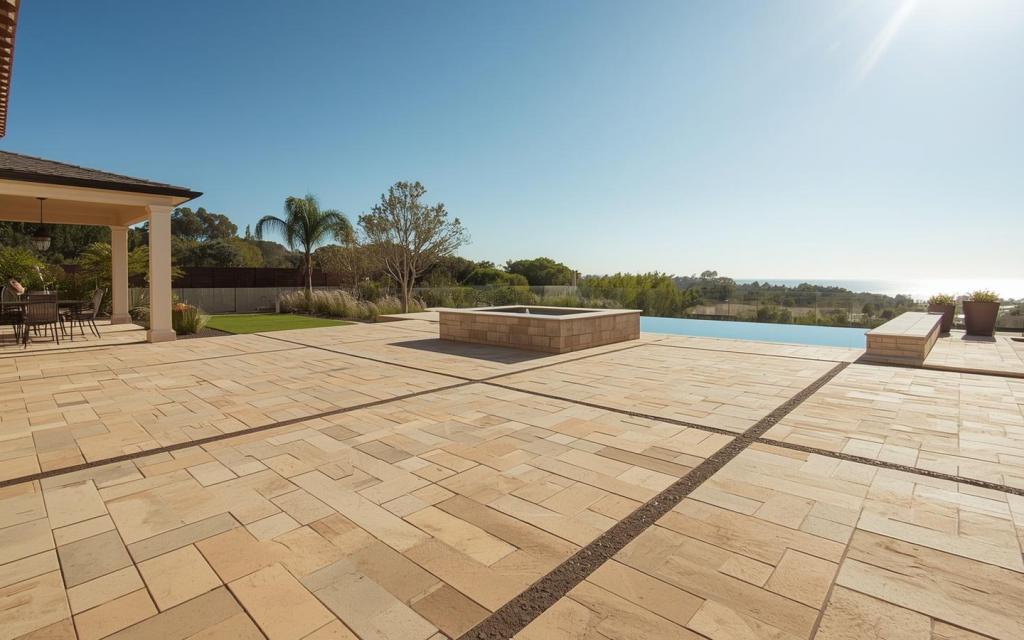
A pool deck is the only surface in your yard that gets walked on by bare wet feet in full afternoon sun. That single sentence explains every decision that matters here — surface temperature, slip resistance, and how the material handles pool chemistry — and it’s why a pool deck is specified differently from a patio.
We rebuild decks around existing pools and build new ones as part of a whole backyard. The general paver build standard is on our paver installation page; everything below is what changes when there’s water involved. If the pool itself is part of the project rather than already there, see pool construction.
Surface temperature is the number one complaint
More people regret a hot pool deck than any other outdoor material choice. In San Diego sun a dark, dense surface becomes genuinely painful to cross barefoot in the afternoon, and no amount of good looks compensates for a deck nobody will walk on.
Three things drive it, in order of impact:
- Colour. Light, pale materials reflect rather than absorb. This matters more than the material type — a light concrete paver will outperform a dark travertine.
- Material and porosity. Travertine is the standout here: porous, light, and it genuinely stays cooler underfoot than dense alternatives. It’s why it’s so common around pools.
- Shade. A patio cover, a pergola or a well-placed tree over the main walking route does more than any material upgrade. Even partial afternoon shade on the primary path transforms usability.
The practical test is simple and worth insisting on: get a sample of your shortlisted material, leave it in direct sun for a couple of hours on your own deck orientation, and stand on it barefoot. Showroom samples at room temperature tell you nothing about this.
Slip resistance, and what to refuse
A pool deck is wet by design. The surface needs enough texture to give grip with a film of water on it, which rules out anything polished or highly glazed no matter how good it looks dry. Tumbled, brushed, shot-blasted and naturally cleft finishes all work; a high-gloss porcelain does not belong within a few feet of water.
If you want porcelain — and there are good reasons to, below — specify an exterior, textured, slip-rated product rather than the indoor version of the same tile. Manufacturers publish slip ratings for exactly this purpose. There’s also a balance to strike: an aggressively rough surface grips well and is unpleasant to sit or kneel on, and harder to keep clean. Moderate, consistent texture is the target.
Materials, judged for poolside
- Travertine — the popular choice for good reason: cool underfoot, naturally textured, and an elegant look. It’s softer and more porous than the alternatives, so it wants sealing, and it will show its age with character rather than staying pristine.
- Porcelain pavers — extremely low absorption, excellent stain and UV resistance, and dimensionally very consistent. The best performer against pool chemistry and coastal salt. Specify a textured exterior grade, and expect higher labour because it’s harder to cut.
- Concrete pavers — the value option and entirely appropriate. Choose a light colour and a textured or tumbled finish. The widest range of shapes and the easiest to source spares for later.
- Shell stone and other light natural stones — cool and distinctive, generally porous and wanting sealing.
- Flagstone — beautiful and irregular; check the specific stone for heat and for a surface that isn’t slick when wet.
One material to be wary of near a pool: anything with a high iron content can rust-stain over time in constant wet-dry cycling. Worth asking about with natural stone specifically.
Coping is the detail that makes or breaks it
Coping is the capping course at the pool’s edge, and it’s doing more than looking good — it’s the transition between the pool structure and your deck, and the two move independently.
- Bullnose — a rounded edge, comfortable to grab and to sit on, and the kinder option for shins and elbows. The traditional choice.
- Square or straight-edge — a crisp contemporary line. Looks superb and is less forgiving underfoot.
- Cantilevered — the deck material wraps over the bond beam with no separate coping piece, for a very clean modern look.
Two technical points that matter far more than the profile. First, coping is mortared to the pool’s bond beam, not floated on sand like the field pavers — it’s a fixed element against a rigid structure. Second, there must be a proper expansion joint between the coping and the deck. The pool shell and the deck expand and contract at different rates, and without a compressible joint that movement pushes on the coping. A hard-grouted junction there is a crack waiting to happen, and it’s one of the most common shortcuts on a cheap deck. That joint also needs to stay maintained — it’s a wear item, not a permanent seal.
Where the water goes
Deck drainage around a pool has a requirement patios don’t: water has to run away from the pool, not into it. Splash-out is fine; deck runoff carrying dirt, fertiliser, leaf debris and whatever else is on the surface back into the water is not — it loads your filtration and shifts your chemistry.
So the deck slopes gently away from the coping on all sides, and that water then needs somewhere deliberate: area drains, a channel drain at the low point, or a graded route to a swale. On a tight lot where the deck is hemmed in by the house on one side and a wall on the other, that routing is a design problem to solve up front rather than a detail to improvise. Water must also not be sent toward the house or over a property line. Where the pool sits below the surrounding grade, a channel drain on the uphill side intercepting runoff before it reaches the deck is usually the answer.
Pool chemistry, salt systems and coastal air
Pool water is chemically active, and it lands on your deck constantly. Chlorinated splash-out will lighten some materials over years. Salt chlorine generators are harder on surroundings than many owners expect — salt crystallising in a porous material as it dries is a slow mechanical stress, and it’s the main reason low-absorption surfaces like porcelain are favoured on salt pools.
Near the coast that effect compounds with marine air. If you’re within a few miles of the ocean and running a salt system, favour dense low-absorption material, seal anything porous, and specify corrosion-resistant hardware on any adjacent gate, rail or fixture. Efflorescence — a temporary white bloom on new concrete pavers — is a curing phenomenon that weathers off and is not a defect; persistent white deposit on an older deck is usually mineral from pool water or irrigation, which is a different problem with a different fix.
Replacing the deck around an existing pool
Most of our pool deck work is a replacement, usually of cracked concrete, and the sequence has a wrinkle: the existing deck often includes cantilevered concrete coping poured over the bond beam. Removing that has to be done carefully, because the bond beam is part of the pool structure and damaging it is a pool repair, not a deck repair.
Beyond that, the things we establish before quoting a replacement: whether the old deck’s drainage was ever correct or whether it’s been running toward the house, what the finished height needs to be so the coping sits right relative to the waterline and any adjacent door thresholds, whether skimmer lids and equipment access stay usable, and whether any deck-mounted rail or ladder anchors need to be reset into the new surface. Autofill lines, deck jets and in-deck cleaners all live under there too.
Layout and safety
A deck that’s generous on paper is often tight in use. Loungers need real depth behind them, a dining set needs chairs pulled out, and there should be a circulation route around the pool that doesn’t require stepping over someone. Getting the deep-end side wide enough for people to stand and talk changes how the pool gets used.
Also worth planning at design stage rather than after: equipment access so the pad can be serviced without walking through the seating area, a route for a cleaning pole that doesn’t cross the dining table, lighting for evening use, and where an outdoor kitchen or fire feature sits relative to the water and the prevailing breeze.
California requires safety barriers around residential pools, and the specific requirements depend on the jurisdiction and on when the pool was built. If your deck project changes a fence line, a gate, or access to the pool area, that’s worth confirming with the building department as part of the permit rather than discovering at inspection. We handle that determination as part of the scope.
What drives the cost
- Square footage and how much of the perimeter is curved — pools with radius ends generate far more cutting than rectangles.
- Material — travertine and porcelain both carry higher material and labour cost than concrete pavers.
- Coping — linear footage, profile, and whether existing cantilevered concrete has to come off the bond beam.
- Demolition and disposal of the old deck.
- Access — a pool in a back yard reached only through a side gate means everything moves by wheelbarrow.
- Drainage work — added area or channel drains and their outlets.
- Grade correction, if the old deck drained the wrong way.
- Sealing, on porous materials.
- Resetting rails, ladders, skimmer lids and any in-deck fittings.
Common questions
What’s the coolest pool deck material?
Light-coloured travertine is the usual answer, because it’s both pale and porous. But colour matters more than material — a light concrete paver beats a dark stone. And shade over the main walking route beats any material choice.
Can you replace my deck without touching the pool?
Usually, yes. The exception is coping: if the existing deck has cantilevered concrete over the bond beam, that has to be removed carefully and new coping set. We protect the pool throughout and keep the water in it.
Do pavers work with a salt water pool?
Yes, with the right material. Salt is harder on porous surfaces, so favour low-absorption materials like porcelain, or seal a porous one and maintain the seal. Specify corrosion-resistant hardware on anything metal nearby.
Why did my old concrete deck crack?
A concrete deck is a rigid slab in expansive soil next to a rigid pool shell, and the two move differently. Cracking is close to inevitable. A paver field flexes instead, and individual units lift and re-lay — which is the main reason people switch.
Do I need to seal a pool deck?
On porous materials like travertine, yes, and periodically thereafter. On concrete pavers it’s optional but makes stains easier to lift. On porcelain it’s generally unnecessary.
How long does a pool deck take?
Longer than an equivalent patio, because of demolition, the coping work, and the extra cutting around a curved perimeter. We’ll give you a sequence including when the pool is unusable and when equipment access is affected.
What coping options work with a paver pool deck?
Coping is the edge that caps the pool shell. Bullnose pavers, precast concrete coping, natural stone and porcelain all pair with a paver deck. Rounded profiles are comfortable to sit on and safer for swimmers; square profiles suit modern pools. We match the coping to the deck pattern and color so the edge reads as a deliberate frame rather than an afterthought.
How do you keep a paver pool deck from getting slippery?
Choose a paver with a textured or tumbled surface rather than a smooth, polished face, and avoid glossy sealers around the water. Most concrete and travertine pavers have good wet traction as installed. Proper slope, about a quarter inch per foot away from the pool, keeps standing water off the surface, which matters as much as the paver texture.
Do pool deck pavers need special drainage?
The deck is graded so splash-out and rain run away from the pool and the house, toward planted areas or a drain. The joints in a paver deck let water through, which reduces puddling compared with a slab, and the base under the pavers is built to drain. Around pool equipment and where the deck meets turf or planting we add drains as needed so nothing sits wet.
How wide should a pool deck be?
Plan at least four feet of clear walkway around the pool for safe circulation, and eight to twelve feet on the side where you want loungers, a dining table or an outdoor kitchen. Building the deck as part of a full patio plan usually works better than a narrow ring of pavers, because the space then supports how you will actually use the yard.
Can the pool deck flow into a patio, turf or a fire pit area?
Yes, and that is usually the goal. The same pavers can run from the pool edge into a dining patio and lounge area, with turf or planting breaking up the field so the yard does not feel like one large hard surface. Fire features, outdoor kitchens and shade structures are placed in that plan so pool, patio and lounge read as one designed space.
What about pool equipment pads, fences and gates?
Equipment pads are poured or paved level and out of the main sight lines, with access for service. Pool safety barriers and self-closing gates are required by code, and a deck project is the ideal time to update them because posts and footings can be set in the base. We coordinate the fence line with the paver layout so posts land cleanly in the field.
Get a pool deck quote
We’re a licensed San Diego general contractor, CSLB #1159596. Call (858) 392-6767 and we’ll look at the existing coping, where the deck currently drains, and how the sun tracks across it — those three things shape the build more than the material you pick. See also paver patios and driveways and the full outdoor living scope.
Where we build this
Searching for pool deck installation near you? IO Builders Group handles pool deck installation across San Diego County from our Scripps Ranch office, including:
Also serving Rancho Bernardo, Encinitas and Solana Beach. Licensed design-build general contractor, CSLB #1159596.