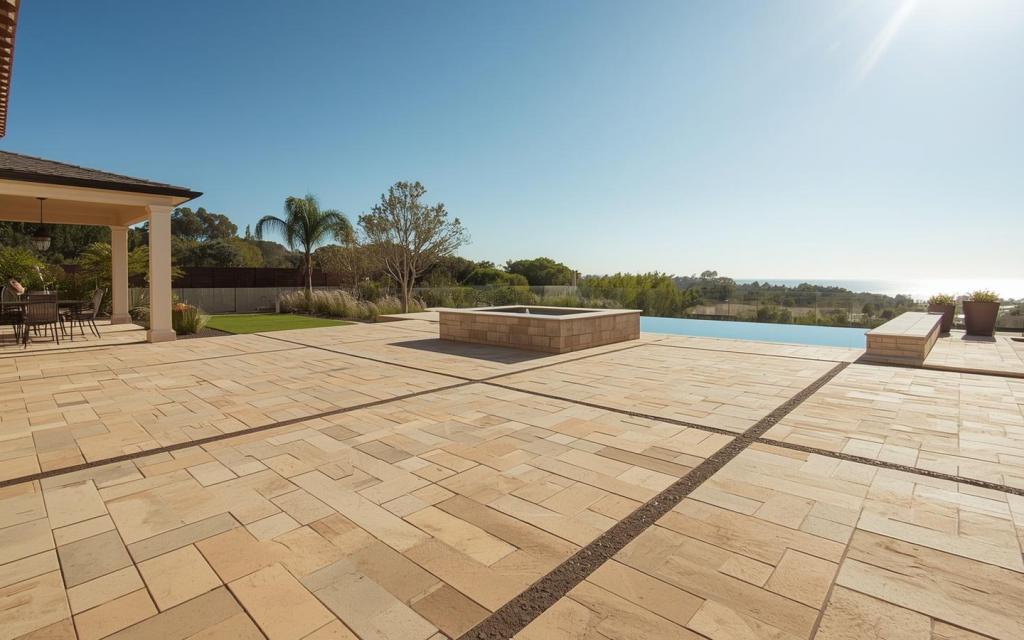
Interlocking pavers are the workhorse of San Diego outdoor design — stronger than poured concrete, immune to the ugly cracking our expansive soils cause, and repairable one stone at a time. Done right, a paver installation is a 25-year surface. Done wrong, it’s a wavy mess in three summers.
“Done right” is mostly what you can’t see: excavation to proper depth, compacted class II road base, correct slope for drainage away from your foundation, edge restraints that hold the field tight, and polymeric sand that locks it all together. That’s our standard on every job.
What we install
- Patios and courtyards — the most common project, and the one where pattern and border choices matter most
- Driveways — vehicular-rated base and paver thickness, not patio spec
- Walkways, entries and steps
- Pool decks and coping — slip resistance and cool-touch surfaces
- Turf-and-paver combination designs — see artificial turf
- Paver ribbons and banding set into concrete or turf
- Retaining and seat walls in matching block — see retaining walls
We install all major manufacturers — Belgard, RCP, Angelus and more — and bring samples to your estimate so you’re choosing against your actual house colour and existing hardscape, not a catalogue photo.
The base is the job
Almost every failed paver installation in San Diego failed below the surface. Pavers themselves rarely break; the base under them settles, and the field goes wavy. A correct build is a sequence, and skipping any step shows up within a few seasons:
- Excavation to depth. A pedestrian patio needs roughly 4–6 inches of compacted base beneath the bedding layer. A driveway carrying vehicle loads needs substantially more — typically 8–12 inches depending on soil. Excavating for a patio and then parking on it is how driveways fail.
- Subgrade compaction. The native soil gets compacted before any base material goes down.
- Geotextile fabric where soils are soft or clay-heavy, separating subgrade from base so the two don’t migrate into each other.
- Class II base in lifts. Compacted in layers, not dumped and rolled once. Each lift gets its own pass with a plate compactor or roller.
- Bedding sand — about an inch, screeded, never used to level out a bad base.
- Laying and cutting the field, with cuts made on a saw rather than snapped.
- Edge restraint. Without it the perimeter creeps outward and the whole field loosens. This is the single most commonly omitted step on cheap installations.
- Compaction of the field, then polymeric sand swept into the joints and activated.
Slope matters as much as compaction. Hardscape should shed water away from the house at a consistent fall — typically around a quarter inch per foot — and it should discharge somewhere deliberate. A beautifully built patio that drains toward your foundation is a defect, not a feature.
Paver materials, and how they behave here
- Concrete interlocking pavers — the default for good reason: the widest colour and shape range, consistent dimensions, strong, and the least expensive per square foot of the durable options.
- Permeable pavers — wider joints filled with open graded aggregate so water passes through into a stone reservoir instead of running off. Genuinely useful on flat lots with drainage problems, and relevant to stormwater requirements on some projects.
- Porcelain pavers — dense, very low absorption, extremely colour-stable in strong sun. Excellent around pools. Less forgiving to cut and install, so labour runs higher.
- Travertine — stays notably cooler underfoot, which is why it’s popular on pool decks. Softer and more porous than porcelain, so it wants sealing.
- Clay brick — holds its colour essentially forever because the colour is the material, not a pigment. A natural fit on Spanish and traditional homes.
- Natural stone — flagstone and cut stone, set on a proper base rather than mortared onto a slab.
Patterns, and where each one belongs
Pattern is not purely aesthetic. Herringbone, laid at 45 or 90 degrees, mechanically interlocks under load and is the correct choice for any surface that carries vehicles — it resists the creeping displacement that tyre loads cause. Running bond is clean and economical and perfectly fine for patios and walkways. Basketweave reads traditional. Ashlar and modular blends mix several stone sizes for a less repetitive field, which hides minor variation well on large areas. Circle kits make a natural anchor for a fire feature or a dining table.
A contrasting border or soldier course around the perimeter does two things: it frames the field visually, and it gives the edge restraint something clean to hold. On large patios it also lets us absorb dimensional variation at the edges rather than in the middle of the field, where you’d see it.
Driveways are a different specification
A paver driveway is not a patio that cars drive on. It needs thicker units — typically 80mm rather than the 60mm common on patios — a deeper compacted base, herringbone laying pattern, and a properly detailed transition at the street apron and the garage slab. Turning movements are what punish a driveway: cars pivoting in one spot concentrate load and shear far more than straight driving does, which is exactly where an under-built base reveals itself first.
Full detail on base depth, the street apron, garage threshold and drainage is on our paver driveways page. The upside over poured concrete is real. A driveway you can lift, repair and re-lay is worth a great deal over twenty years, particularly when a trench for a utility or an irrigation line has to cross it. With concrete, that trench is a permanent visible scar. With pavers, the stones come up and go back down.
Pool decks
Around water, three things drive the choice: surface temperature in full sun, slip resistance when wet, and how the material handles pool chemistry and, near the coast, salt air. Travertine and porcelain both perform well. Coping is its own decision — bullnose for a softer edge underfoot, square-cut for a more contemporary line — and it needs to be detailed properly against the pool shell rather than simply butted up to it. Full detail on cool-underfoot materials, slip ratings, coping and drainage is on our pool deck pavers page. If a pool is part of the project rather than already there, see pool construction.
San Diego soil, sun and slope
Our expansive clay soils swell when wet and shrink when dry, and that cycle is what cracks poured concrete. It’s also the strongest argument for a flexible paver system: a field of individual units accommodates minor ground movement that would fracture a monolithic slab. What expansive soil demands in return is a properly compacted base and honest drainage — the movement gets worse where water collects.
Coastal properties deal with salt air, which favours dense, low-absorption materials and stainless or coated fasteners on anything adjacent. Inland, the variable is heat and UV: strong sun will fade pigmented products over many years, and a through-coloured material like clay brick or a colour-stable porcelain holds up better than a surface-pigmented one. On sloped lots, pavers often pair with a retaining wall to create usable flat terraces, and the two should be engineered together rather than sequenced as separate projects.
Many San Diego neighbourhoods also carry HOA architectural review for visible hardscape, particularly driveways and front walkways. It’s worth knowing before you fall in love with a colour.
What drives the cost
- Square footage — larger areas cost less per square foot, because mobilisation and setup amortise.
- Pedestrian vs. vehicular — the deeper base and thicker units on a driveway are a genuine step up in both material and excavation.
- Excavation and disposal — demolishing an existing slab, or hauling out spoil from a deep cut, is real cost before a single paver arrives.
- Access — a backyard reachable only through a narrow side gate means material moved by wheelbarrow instead of machine. This is one of the biggest hidden variables in any hardscape quote.
- Material choice — porcelain and natural stone carry both higher material cost and higher labour.
- Cuts and complexity — curves, circle kits, inlays and multiple borders all add saw time.
- Drainage work — area drains, channel drains or a dry well tied into the build.
- Grade change — steps, terracing or a wall to make a sloped yard usable.
Maintenance, honestly
Pavers are low maintenance, not no maintenance. Expect to top up polymeric sand in the joints eventually, particularly in a driveway’s wheel paths. Sealing is optional on concrete pavers and genuinely useful on porous natural stone; it deepens colour and makes spills easier to lift, and it needs redoing periodically. Efflorescence — a temporary white haze from the curing process — is normal on new concrete pavers and weathers off on its own; it is not a defect and it does not need aggressive treatment. Weeds in the joints are a sign the polymeric sand has degraded rather than an inevitability. Individual stained or damaged stones lift and get replaced, which is the whole advantage of the system.
Common questions
Pavers vs. stamped concrete?
Concrete is cheaper on day one; pavers win every year after. Concrete cracks — our soil guarantees it — and stamped patterns can’t be patched invisibly. Pavers flex, drain better, and individual stones can be replaced. If budget points you to concrete, that’s a legitimate choice and we build it too — see concrete construction.
How long does a typical patio take?
Most residential patios run 3–7 working days depending on size and access. Driveways take longer because of the deeper excavation and base work, and because the apron transition needs care.
Can you lay pavers over an existing concrete slab?
Sometimes. It requires a sound, properly draining slab and it raises the finished height, which can cause problems at thresholds, gates and steps. If the slab is already cracked or holding water, overlaying it just hides a problem that will telegraph through. We’ll tell you honestly which situation yours is.
Will my pavers fade?
Slightly, over many years, and more noticeably on deeply saturated colours in full sun. Through-coloured materials like clay brick and colour-stable porcelain hold up best. Choosing a mid-tone blend rather than a single flat dark colour also makes any change far less visible.
Do I need a permit?
Typically not for a patio at grade. Driveway aprons in the public right of way, retaining walls above a certain height, and anything changing site drainage can all trigger review. We handle that determination as part of the project rather than leaving it to you.
Do you install permeable pavers?
Yes. They’re worth considering on flat lots with nowhere obvious to send runoff, and where a project needs to manage stormwater on site. The base build is different — an open graded stone reservoir rather than conventional class II — so it’s a decision to make during design, not after.
How thick should pavers be for a patio versus a driveway?
Pedestrian areas such as patios, walkways and pool decks use 60 mm (about 2 3/8 inch) pavers. Anything that carries vehicles, including driveways, parking pads and the apron at the street, should use 80 mm (about 3 1/8 inch) pavers on a deeper base. Thickness matters less than the base under it, but putting 60 mm pavers on a driveway is a common shortcut that leads to rutting in the wheel paths.
What goes under pavers in San Diego soil?
A proper paver section is compacted subgrade, a geotextile fabric where the soil is soft or clay-rich, several inches of compacted Class II road base, a one-inch bedding layer of coarse sand, the pavers themselves, then polymeric sand swept into the joints and a rigid edge restraint. Patios typically get four to six inches of base and driveways eight to twelve. The base is compacted in lifts, because a base that is dumped and compacted once will settle later.
How do you keep pavers level on clay or expansive soil?
Inland San Diego neighborhoods sit on clay that swells when wet and shrinks when dry. On those lots we excavate deeper, separate the base from the clay with geotextile fabric, compact the road base in thin lifts and pay extra attention to drainage so the subgrade stays as dry as possible. Pavers are actually the best surface for expansive soil because they flex with small movements instead of cracking the way a concrete slab does, and any low spot can be lifted and reset.
Should I seal my pavers, and how often?
Sealing is optional. It deepens color, makes stains easier to clean and helps lock the joint sand in place, but it also needs reapplying every few years and a poorly applied sealer can leave a cloudy film. We usually recommend a breathable, matte penetrating sealer on patios near barbecues and outdoor kitchens, and on driveways where oil drips are likely. Natural stone and some concrete pavers benefit more than others, so we advise product by product.
What is polymeric sand and why does it matter?
Polymeric sand is fine sand blended with a binder that hardens when it is misted with water. Swept into the joints, it locks the pavers together, resists washout, and discourages weeds and ants from taking up residence between the stones. Regular sand does none of that. Expect to top it up occasionally in high-traffic spots and after any repair; that is normal maintenance, not a defect.
Can pavers be installed on a slope?
Yes, within limits. Gentle grades are fine and actually help drainage. Steeper areas are handled with terracing, steps or a low retaining wall so each paver field sits on a stable, well-drained plane. On a sloped driveway we also design the pattern and edge restraint to resist the downhill push of vehicles. What we avoid is laying a large paver field on a steep continuous slope, because water and gravity will eventually move the bedding sand.
How do you stop weeds and ants between pavers?
Weeds and ants live in the joints, not under the pavers, so the fix is a tight, well-filled joint. Polymeric sand, a compacted base that does not hold water, and a rigid edge that keeps the joints from opening up do most of the work. If seeds still land and sprout, a quick spray or hand pull is all that is needed. Landscape fabric under the pavers is not what stops weeds; a good base and sealed joints are.
Get an estimate
We’re a licensed San Diego general contractor, CSLB #1159596, and we build hardscape as part of complete outdoor living projects — so a patio can be planned alongside an outdoor kitchen, a patio cover or turf rather than bolted on afterwards. Call (858) 392-6767 and we’ll walk the space, talk through base and drainage, and bring samples.
Where we build this
Searching for paver installation near you? IO Builders Group handles paver installation across San Diego County from our Scripps Ranch office, including:
Also serving Rancho Bernardo, Encinitas and Solana Beach. Licensed design-build general contractor, CSLB #1159596.